
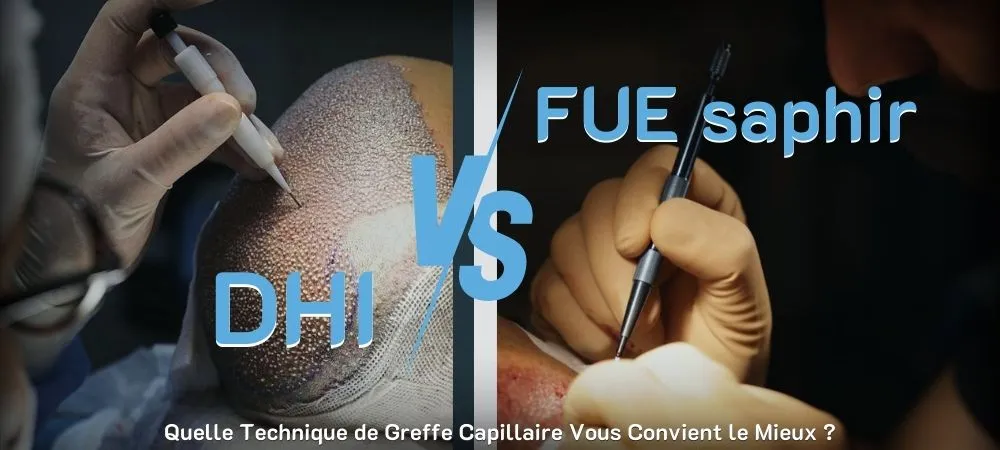
If you are researching a hair transplant in Turkey, you have probably come across two names: FUE Sapphire and DHI. Both techniques share the same first step, but differ on one essential point: how the grafts are implanted. At Turkish Esthetic, we have chosen DHI. Here is why, and how to know whether it is right for you.
What they have in common: graft harvesting
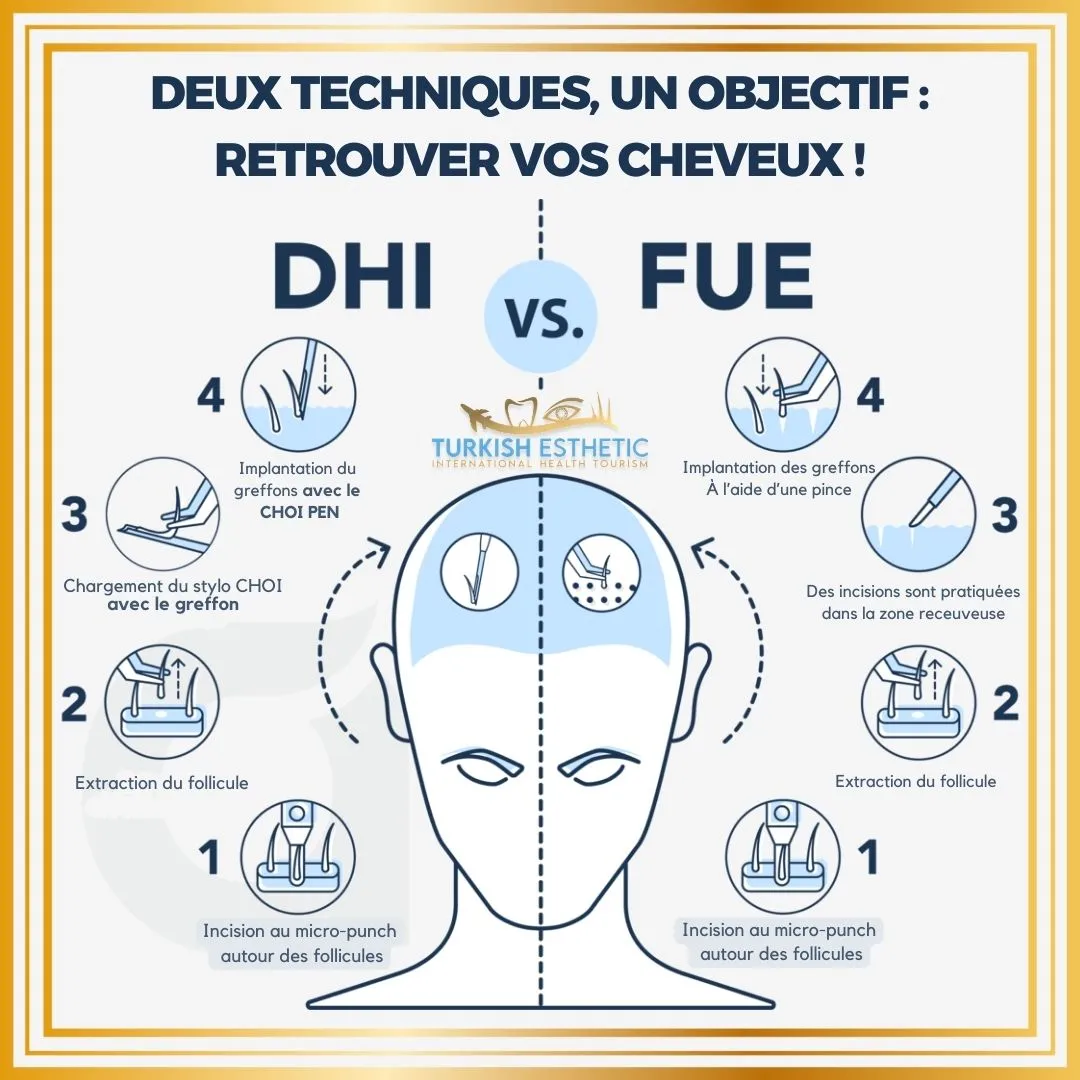
In both cases, follicles are harvested one by one from the donor area, usually the back and sides of the scalp, using a micro-punch. This extraction step is the same: the difference lies in the implantation.
FUE Sapphire in brief
With FUE Sapphire, the surgeon first opens micro-incisions (the “channels”) in the area to be treated using a sapphire blade. The grafts are then placed into these channels one by one with forceps. The procedure is therefore carried out in two separate stages: opening the channels, then placing the grafts.
DHI: direct implantation with the Choi pen
DHI (Direct Hair Implantation) removes the step of opening channels in advance. Each graft is loaded into a Choi pen, a hollow-needle instrument, then implanted directly into the scalp in a single movement.
- Precise control of each graft: angle, depth and direction are set at the very moment of implantation, which is key to a natural-looking hairline.
- Densifying between existing hair: as no channels need to be opened across the whole area, DHI is well suited to strengthening an area that is not completely bald.
- Less time outside the body for the grafts: they are implanted as they are prepared.
- Sometimes less shaving: depending on your case, the recipient area does not always need to be fully shaved. We confirm this during your assessment.
FUE Sapphire vs DHI: comparison
| FUE Sapphire | DHI | |
|---|---|---|
| Harvesting | Micro-punch, graft by graft | Micro-punch, graft by graft |
| Implantation | Two stages: channels opened with a sapphire blade, then grafts placed with forceps | One movement, directly with the Choi pen |
| Control of angle and direction | Set by the orientation of the channels | Set graft by graft, at the moment of implantation |
| Densifying an area with existing hair | More delicate | Well suited |
| Shaving the recipient area | Usually full | Sometimes partial, depending on the case |
Why Turkish Esthetic chose DHI
Our goal is a result that looks as natural as possible: a hairline that suits your face, hair that grows in the right direction, and harmonious density. DHI gives us control over each graft at the moment of implantation, which is why we have made it our reference technique, for hair transplants as well as beard transplants.
When the donor area on the scalp is too limited, DHI can also be combined with BHT, which uses grafts taken from the body.


Is DHI right for you?
The choice depends above all on your donor area, the stage of your hair loss and your expectations. That is why every project starts with a free assessment: you send us a few photos, and our team tells you honestly what can be achieved, including when a transplant is not recommended.
Further reading
- DHI hair transplant in Istanbul
- Hair transplant in Turkey: the complete guide
- BHT, when the donor area is limited
- Why choose Istanbul for your hair transplant
Thinking about a transplant? Send us your photos: our team will review your case for free, with no obligation.
Frequently asked questions
Is DHI painful?
The procedure is carried out under local anaesthetic. Options such as dermojet (needle-free anaesthesia) or conscious sedation can be offered for extra comfort. Discover our anaesthesia techniques.
Do I need to shave my whole head?
The donor area must be shaved for harvesting. For the recipient area, partial shaving is sometimes possible with DHI: we confirm this after reviewing your photos.
When will I see the result?
Regrowth is gradual. The first changes usually appear after a few months, and the result can be assessed after about a year. Every patient progresses at their own pace.
Hair transplant results are specific to each patient. They depend in particular on the donor area, hair characteristics and aftercare.


Pingback: BHT Body Hair Transplant In Istanbul, Turkey | Turkish Esthetic